When a program receives a request, it looks up the corresponding view function based on the URL, which then generates the page to send back to the client. Different URLs map to different view functions — and the mechanism that handles this mapping is called routing. Routing has two parts:
- Generating the URL mapping
- Matching the correct view function for a request
This article analyzes both.
Generating URL Mappings
In the Bottle example from the previous post, we used the @app.route decorator to map the /hello path to the hello view function:
@app.route('/hello')
def hello():
    return 'Hello World!'
Let’s trace through app.route using /hello as our example.
def route(self, path=None, method='GET', callback=None, name=None,
          apply=None, skip=None, **config):
    """
        :param callback: An optional shortcut to avoid the decorator
          syntax. ``route(..., callback=func)`` equals ``route(...)(func)``
    """
    if callable(path): path, callback = None, path
    plugins = makelist(apply)
    skiplist = makelist(skip)
    def decorator(callback):
        if isinstance(callback, basestring): callback = load(callback)
        for rule in makelist(path) or yieldroutes(callback):
            for verb in makelist(method):
                verb = verb.upper()
                route = Route(self, rule, verb, callback, name=name,
                              plugins=plugins, skiplist=skiplist, **config)
                self.add_route(route)
        return callback
    return decorator(callback) if callback else decorator
Note the docstring and the last line — this return pattern means we can also use app.route('/hello', callback=hello) to achieve the same result.
The route method packages our routing rule (/hello), the associated HTTP method (default GET), plugins, and other parameters into a Route object, then adds it to the Router instance via Router.add().
Router.add() partial code:
def add(self, rule, method, target, name=None):
    # do some something
    if is_static and not self.strict_order:
        self.static.setdefault(method, {})
        self.static[method][self.build(rule)] = (target, None)
        retun
    # dynamic path parse
Inside the Router, it maintains two dictionaries: static and dyna_route, for static routes and dynamic routes respectively (dynamic route mapping is similar to static, so I’ll skip it here). Using our example:
static = {
    'GET': {
        '/hello': hello,
    }
}
You can see Bottle ultimately uses a dictionary to store this mapping, and it also adds support for HTTP methods. So it’s no surprise that Bottle’s documentation shows you can decorate the same view function with multiple route decorators:
@app.route('/', method='POST')
@app.route('/', method='GET')
@app.route('/hello', method='GET')
def func():
    pass

static = {
    'GET': {
        '/': func,
        '/hello': func,
    }
    'POST': {
        '/': func,
    }
}
Now that the mapping is generated, how does the program match requests to view functions internally?
Matching View Functions
Quick aside: when I first read this part, I didn’t fully understand WSGI yet. So instead of starting from Bottle.__call__, I just Ctrl+F’d for static to find where this dictionary was used. A brute-force approach, but it got me there. :D
Inside Router.match, you’ll find the static dictionary being accessed. match() pulls the request URL and method from the environ dict, then does a direct lookup in static:
def match(self, environ):
    ''' Return a (target, url_agrs) tuple or raise HTTPError(400/404/405). '''
    verb = environ['REQUEST_METHOD'].upper()
    path = environ['PATH_INFO'] or '/'
    target = None
    if verb == 'HEAD':
        methods = ['PROXY', verb, 'GET', 'ANY']
    else:
        methods = ['PROXY', verb, 'ANY']

    for method in methods:
        if method in self.static and path in self.static[method]:
            target, getargs = self.static[method][path]
            return target, getargs(path) if getargs else {}
        elif method in self.dyna_regexes:
            for combined, rules in self.dyna_regexes[method]:
                match = combined(path)
                if match:
                    target, getargs = rules[match.lastindex - 1]
                    return target, getargs(path) if getargs else {}
I kept tracing upward using a similar approach and eventually drew this call chain:
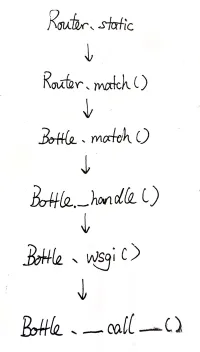
This nicely confirms what we said in the previous post: all request information is stored in environ, and Bottle.__call__ is the entry point for reading the source code.
Inside Bottle._handle(), once the matching route is found, it directly calls the route’s call method — our hello view function:
def _handle(self, envrion):
    route, args = self.router.match(environ)
    return route.call(**args)
Error Pages
When something goes wrong, Bottle shows a default error page — like the familiar 404 page.
Internally, Bottle handles error pages similarly to regular pages. It maintains a dedicated error_handler dictionary for error page mappings, but the key is the HTTP status code rather than an HTTP method or URL.
Similarly, Bottle provides a dedicated @error decorator for custom error pages:
def error(self, code=500)
    def wrapper(handler):
        self.error_handler[int(code)] = handler
        return handler
    return wrapper
When the program can’t find a matching view function, or encounters another internal error, Bottle._handle() raises an HTTPError. Then Bottle._cast() looks up the corresponding error handler in the error_handler dict by status code, and treats the result like a regular page:
Bottle.wsgi()
    out = self._cast(self._handle(environ))
Bottle._cast()
    if isinstance(out, HTTPError):
        out = self.error_handler.get(out.status_code, self.default_error_handler)(out)
    return self._cast(out)
Wrapping Up
Bottle uses dictionaries to store URL mappings for routing and error pages. Now, following the same approach, let’s add routing and a simple error page to our minimal WSGI application:
class WSGIApp(object):

    def __init__(self):
        self.routes = {}

    def route(self, path, method='GET'):
        def wrapper(callback):
            self.routes.setdefault(method, {})
            self.routes[method][path] = callback
            return callback
        return wrapper

    def error_handler(self, envrion, start_response):
        out = [b'Somethind Wrong!']
        status = '404 NotFound'
        response_headers = [("content-type", "text/plain")]
        start_response(status, response_headers)
        return out

    def __call__(self, envrion, start_response):
        path = envrion['PATH_INFO']
        method = envrion['REQUEST_METHOD'].upper()
        if method in self.routes and path in self.routes[method]:
            handler = self.routes[method][path]
        else:
            handler = self.error_handler
        return handler(envrion, start_response)


app = WSGIApp()

@app.route('/')
def simple_app(envrion, start_response):
    out = [b'Hello World!']
    status = '200 OK'
    response_headers = [("content-type", "text/plain")]
    start_response(status, response_headers)
    return out


if __name__ == '__main__':
    from wsgiref.simple_server import make_server
    with make_server('', 8000, app) as httpd:
        print("Server is Running...")
        httpd.serve_forever()